

Showing posts with label Romero. Show all posts
Showing posts with label Romero. Show all posts
Monday, December 15, 2008

50-X Ratio_Voronoi Skin Formations
Romero
The following diagrams show the geometric generation of voronoi systems from its basic level to a more complex one.

Study of voronoi systems applied on curved surfaces.

Analysis of curvature to identify efficient zones on the skin that will perform successfully to the structural supports. The green areas indicate those zones.

Study of relationship between skin and structural supports (green areas).

Selection of the structural-supports location on both:the curved voronoi grid of the skin and the planar voronoi surface of the ground.
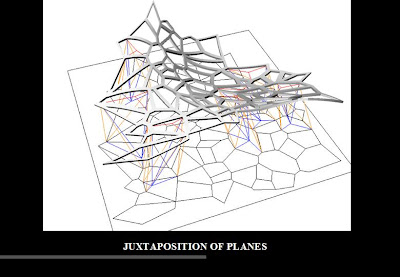

Diagram showing the skeleton of the structure based on the voronoi skin and the triangular structure that follows a voronoi geometry as well.

The following diagrams show the geometric generation of voronoi systems from its basic level to a more complex one.

Study of voronoi systems applied on curved surfaces.

Analysis of curvature to identify efficient zones on the skin that will perform successfully to the structural supports. The green areas indicate those zones.

Study of relationship between skin and structural supports (green areas).

Selection of the structural-supports location on both:the curved voronoi grid of the skin and the planar voronoi surface of the ground.

Juxtaposition of planes by means of structural supports based on triangulation.

Diagram showing the skeleton of the structure based on the voronoi skin and the triangular structure that follows a voronoi geometry as well.


Wednesday, December 3, 2008


Thursday, October 9, 2008
Assignment 03: PERFORMANCE ANALYSIS

Romero
The performance analysis of the project seeks to evaluate the behavior of different triangular structures in relation to the loads applied to them. It is notorius the direct influence that the shape of the roof generates on the distribution of loads. The more the pyramidal roof gets closer in shape to a sphere, the more uniform the forces are dispersed on the surface. That premise allows to select a specific structure according to the scale of the space to be created. For instance, to cover a large space using the stuctural modules, it would be more convenient in terms of efficiency to work with those that have more sides in their pyramidal roof (six, seven, eight or even nine sides). The other modules with three to five sides become more effective if the space is meant to gather a low number of individuals (two to six approximately).
Thursday, September 25, 2008
Assignment 02: X Ratio Architectural Assemblage

Romero
From the morphological study of the tomato, the helix which represents its main internal structure has been translated to generate a triangular composition that functions as a pergola. The different planes created by the metal tubes makes possible the addition of triangular surfaces such as the case of the roof. These surfaces can even be shared by the adjacent triangular plan just by simple rotation. The study of performance seeks to concentrate on that particular feature of the structure.
Tuesday, September 16, 2008


Subscribe to:
Posts (Atom)