
Abigore, a Japanese robot from a distant future, is comprised of many disparate parts that perform diametrically. The robot is designed to function as a battle-droid; ready for combat, however his construct is geared mainly towards aerodynamics in flight. Joint pieces are utilitarian in nature with casings that are anthropomorphic and are distinguished from their more aerodynamic breathren through simple color coding.
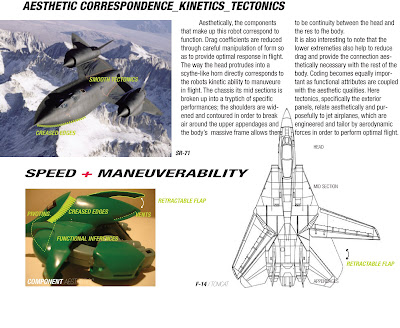
Aesthetically, the components that make up this robot correspond to function. Drag coefficients are reduced through careful manipulation of form as to provide optimal response in flight. The way the head protrudes into a scythe-like horn directly corresponds to the robots kinetic ability to manuveure in flight. The chassis its mid sections is broken up into a tryptich of specific performances; the shoulders are widened and contoured in order to break air around the upper appendages, and the body’s massive frame allows there to be continuity between the head and the rest of the body. It is also interesting to note that the lower extremeties also help to reduce drag and provide the connection aesthetically necessary with the rest of the body.
The range of Abigor’s movements are confined to subtle hinges and pivots that in flight would be able to efficiently facilitate his maneuverability. Coding becomes equally important as functional attributes are coupled with the aesthetic qualities. Here, tectonics, specifically the exterior panels, relate aesthetically and purposefully to jet airplanes, which are engineered and tailored by aerodynamic forces in order to perform optimal flight. The morphology of the playplanter is regulated by tracing the profile curvature of some of Abigor’s aerodynamic shell. In this version, the scale does not yet engage adult height. Further analysis will critique this iteration sufficiently enough to create a critical rubric.
For measures of performance, the group chose to analyze the inherent performative qualities of a Japanese Gundam warrior. The analysis involved understanding the design techniques employed on the toy in order to calibrate and direct our investigations into possible readaptation of/for performance. Using advanced modeling techniques as well as analytical software we looked to see how the particular creasing occuring on the model could be increased in scale and intention. At times directing, at other times influencing the design process was a critical understanding of how inflections in form can create ecologies and moments for cover and repose.
The overall scheme of the design at this scale, is composed of cavity-like spaces, accommodating ecological growth at these collective anomolies as well as instances of shelter and youthful inhabitation of jungle gym occurences. These cavities are produced by the protrusions of this aggregated system of components at certain intervals to allow structural capability.
Smooth, continuious deformations of the original iteration preserve ecological cavities for optimal water collection and solid volumous spaces decompose into skeletal monkey bars that course through the center of the system. The structural components pierce the undulating landscape at concave points to generate overall stability without sacrificing aesthetical aerodynamic flow from the body to the groundplane.
Showing posts with label Diptee-Gaudrault-Valdes. Show all posts
Showing posts with label Diptee-Gaudrault-Valdes. Show all posts
Wednesday, December 17, 2008

Tuesday, December 16, 2008
Creased performance

The final iteration of our design manifested three different bodies of program. A canopy condition addressed issues of air flows and water. The second condition acted more as a way of inserting a playground typology, monkey bars. The last body mostly embedded in the ground served as planters for recreation and enjoyment. The sectional distribution of these components allows children to play through and on top of the structure.
If imbedded into the ground, these planters would beginning to play with notions of natural and artificial surface. In order to quantify the funtionality of its design, we implemented a series of studies on a previous iteration: where this structure meets the ground, the integrity of the surface itself, as well as its ability to direct water away and into the openings. These studies showed us some necessity to recalibrate the topology of the structure in order to perform effectively.
We realized that the method of modeling was as important as the model itself. Switching from laminar to volumetric modeling allowed a continuous topology to embrace and redirect different flows of air and water.
Monday, December 15, 2008


Friday, October 10, 2008
X-RATIO_ABIGOR_PLANTING

After revising the last iteration of our design, we thought about how the connection between the head and the body in Abigor created an interesting opening that our last design did not take advantage of. In this iteration, essentially, the head and body of Abigor has been aggregated and distorted along traces that coincide with some of the curvature found on Abigor's body. The intention here is to requalify the function of that seperation in order to attribute it as an opening for vegetation. The idea here is that through the change in opening size, the amount of vegetation that can grow will change as well. More over, this aggregation allows there to be an interaction between humans as well. The sectional distribution of these components allows children to play through and on top of the structure. If imbedded into the ground, this planter would beginning to play with notions of natural and artificial surface.
 In order to quantify the funtionality of this design, we implemented a series of studies: where this structure meets the ground, the integrity of the surface itself, as well as its ability to direct water away and into the openings. These studies showed us some
necessity to recalibrate the topology of the structure in order to perform effectively.
 The use of the magnetic field study helped us understand where the structure touched the ground. This study showed us the need to recalibrate those moments in order for the structure to provide adequate support when suspension occurs. By analysing the draft angle of the topology were found moments where torsion would lead to structural failure. Our next iteration will hope to minimize these occurences. In the final analysis, the distribution of water along the surface was helpful in determining how topology can influence accumulation and friction. Excessive surface friction and acumulation disrupted the porousity of the structure.

Friday, September 26, 2008
Furniture


The aggregation and manipulation of one of the morphological pieces from Abigor lead to possible uses in furniture and wall treatments. More as a malleable surface that has enough rigidity to stand in place where needed. Its porosity has interesting applications when imbeded into the ground, structuring patterns of growth.
Wednesday, September 10, 2008


Friday, September 5, 2008



Subscribe to:
Posts (Atom)